“I Didn’t Think My Fat Freezing Had Worked” - Until We Compared the Photos
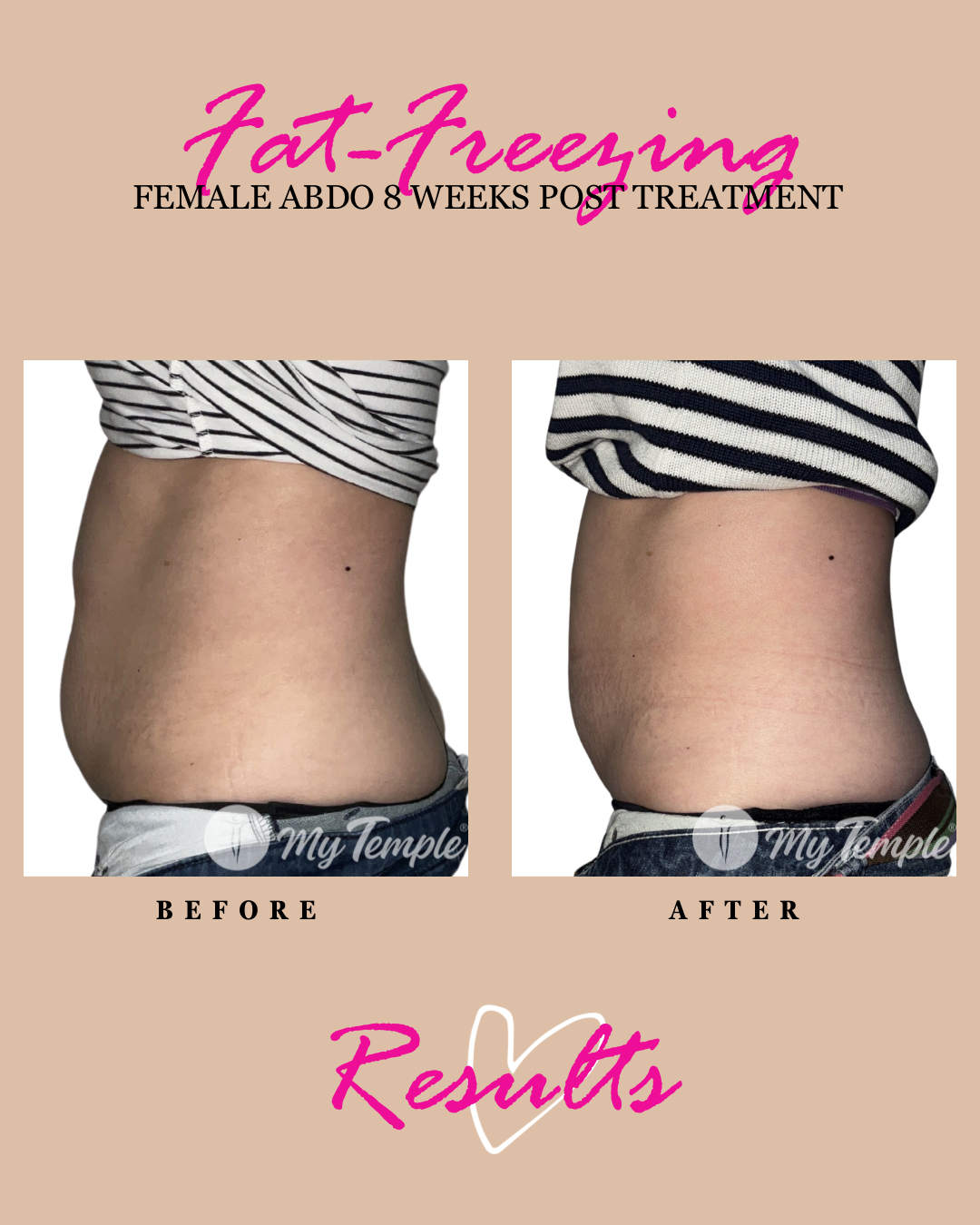
One of the interesting things about fat freezing is that sometimes other people - or the camera - notice the change before you do.
This was exactly what happened with one of our 45-year-old female clients after having fat freezing on her lower abdomen.
When she returned to My Temple for her 8-week follow-up appointment, she wasn't convinced that much had changed.
She looked at her tummy every day. Her jeans didn't suddenly feel dramatically looser. There hadn't been one morning when she'd woken up and thought, “Wow — my stomach has changed!”
So, understandably, she wasn't really sure whether her treatment had worked.
Then we pulled up her before photos.
And suddenly the difference was much easier to see.
Why hadn't she noticed the change?
Fat freezing doesn't produce an overnight transformation.
Cryolipolysis works by cooling targeted subcutaneous fat cells to a controlled temperature. Following treatment, the affected fat cells undergo a biological process and are gradually cleared by the body over the following weeks and months.
That means the change happens little by little.
And that's precisely why it can sometimes be difficult to see your own result.
Imagine looking at yourself in the mirror every morning while a change is occurring incredibly gradually.
There isn't necessarily a single day when you suddenly look different.
Instead, yesterday looks almost identical to today.
Today looks almost identical to tomorrow.
But compare today with eight weeks ago, and the difference may be much easier to recognise.
In this client's case, she'd also simply forgotten exactly what her lower abdomen looked like before treatment.
That's completely understandable. Most of us don't have a perfectly accurate mental photograph of our body from two months ago.
It's one of the reasons we take standardised before-and-after photographs and measurements at My Temple.
This client had actually lost 6cm off the circumference on her lower belly - and although this doesn’t sound huge, it would be equivalent to about 3- 5kgs of weight loss and/or a size smaller in her jeans if the treatment was conducted where the jeans do up. Remembering that the waistband of the jeans is much higher than her lower belly in this example.
“But my jeans don't feel any looser…”
This was another interesting part of her follow-up.
She hadn't noticed a significant difference in the fit of her jeans, which had contributed to her feeling that perhaps the treatment hadn't done very much.
But when we looked at where her jeans actually sat, the reason became fairly obvious.
The waistband wasn't sitting across the area we had treated.
Her treatment had specifically targeted the lower abdominal pocket of fat below the waistline.
Fat freezing is a body-contouring treatment. It doesn't make fat disappear evenly from your entire abdomen, hips and waist.
We assess the individual pocket of subcutaneous fat and position the applicator to target that particular area.
So if we treat the lower abdomen, you shouldn't necessarily expect the waistband of your jeans to suddenly become several centimetres looser — particularly if the waistband sits above the treated area.
What we want to assess is:
Did the area we actually treated change?
In this case, comparing her photographs and measurements gave us a much better way of answering that question.
This is why we measure fat-freezing results.
There are several ways people try to judge whether their fat-freezing treatment has worked.
The mirror.
Their clothes.
The scales.
How they feel.
All can be useful, but none is perfect.
Body weight, for example, can fluctuate because of hydration, food intake, hormones and many other factors — and fat freezing isn't designed as a weight-loss treatment in the first place.
Clothing can also be misleading because it may not sit directly over the area being treated.
That's why at My Temple we like to compare like with like.
We look at the treated area, review the before-and-after photographs and consider the measurements taken during the client's treatment journey.
For this client, seeing those comparisons changed her perception of her result.
Sometimes you need to look backwards to see how far you've come.
There's something quite funny about gradual change: you can become accustomed to the new version of yourself before you've even realised it's new.
When you see your body every single day, your mental picture keeps updating along with it.
That's why an eight-week-old photograph can be surprisingly powerful.
Instead of asking:
“Do I look different from yesterday?”
we can ask:
“How does the area we treated today compare with the same area before treatment?”
That's a much more useful question.
And sometimes, as this client discovered, the answer is sitting right there in the before-and-after photographs.
Considering fat freezing for your lower abdomen?
Not every tummy — and not every type of abdominal fat — is suitable for fat freezing.
At My Temple, we assess the location, amount and distribution of the fat, discuss what you'd actually like to change, and determine whether cryolipolysis is an appropriate treatment for that particular area.
Because the goal isn't simply to “have fat freezing.”
It's to treat the right area, on the right person, with realistic expectations about the result.