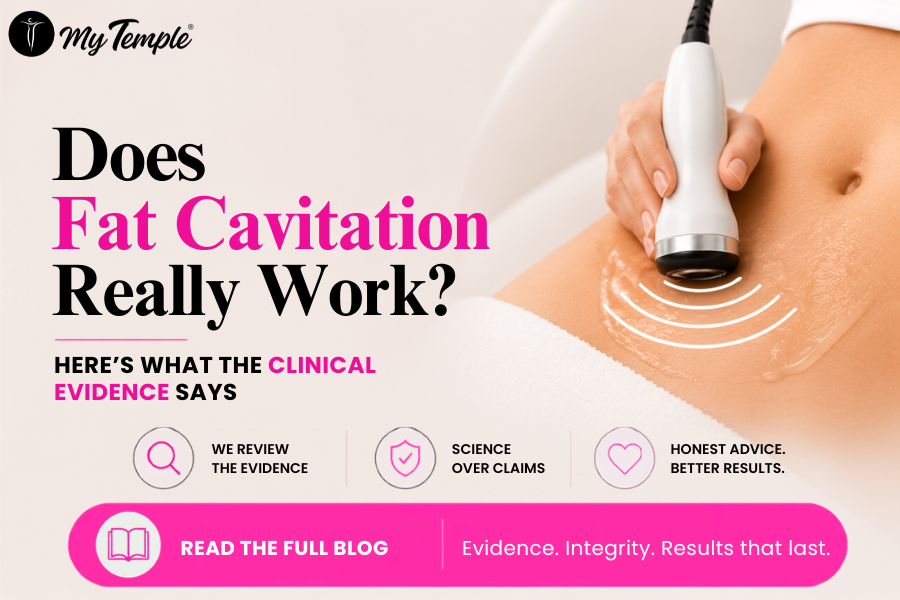
Does Fat Cavitation Really Work? Here's What the Clinical Evidence Says
One of the most common things we hear from new clients at My Temple is:
"I've already tried fat cavitation... but I didn't notice any difference."
If you've had a similar experience, you're certainly not alone.
Many people come to us feeling disappointed after investing hundreds or even thousands of dollars into fat cavitation treatments, only to find that the stubborn fat they wanted to reduce is still there.
As clinicians, that's frustrating for us too.
Not because we want to criticise another treatment—but because we genuinely want people to spend their money on treatments that have strong scientific evidence behind them.
In fact, if fat cavitation consistently worked and the clinical evidence proved long-term fat reduction, we would absolutely offer it at My Temple.
But after reviewing the published research, we simply can't recommend it as a treatment with proven long-term results.
What Is Fat Cavitation?
Fat cavitation, also known as ultrasonic cavitation or ultrasound cavitation, uses low-frequency ultrasound waves that are claimed to disrupt fat cells beneath the skin.
Many providers describe the treatment as a non-surgical alternative to liposuction and often promote it as a way to permanently reduce stubborn fat.
It sounds impressive.
But marketing claims and scientific evidence are not always the same thing.
Does Fat Cavitation Really Work?
The short answer is...
It may produce small short-term changes in some people, but there is currently very little high-quality evidence proving that standard fat cavitation provides reliable, long-term fat reduction.
When we reviewed the published clinical studies, we found that some research reported temporary reductions in body measurements immediately after a course of treatments.
However, temporary changes immediately after treatment are very different from proving that fat has been permanently removed.
The question that really matters is:
What happens six months or twelve months later?
Unfortunately, this is where the evidence becomes much weaker.
What Does the Research Say?
One of the better-quality clinical studies followed women for six months after a course of ultrasound cavitation treatments.
The researchers found that ultrasound cavitation alone did not produce a significant long-term reduction in waist circumference, while participants receiving radiofrequency treatment maintained measurable improvements over the same period.
That means the study did not demonstrate that ultrasound cavitation alone produced lasting fat reduction.
More recent research published in 2025 reported reductions in superficial abdominal fat for approximately two months after treatment. However, the researchers concluded that more studies are needed to determine whether these results are maintained long term.
Simply put...
There is currently no strong body of clinical evidence proving that standard fat cavitation permanently removes fat cells or consistently produces long-term fat reduction.
Why Do Some People Think It Works?
This is an important question.
Immediately after treatment, it's possible to see changes in body measurements for reasons that aren't necessarily permanent fat loss.
These can include:
Temporary fluid shifts
Changes in tissue hydration
Mild inflammation
Normal day-to-day fluctuations in waist measurements
That's why high-quality research follows patients for months after treatment—not just immediately afterwards.
Without long-term follow-up, it's impossible to know whether a reduction in centimetres represents genuine fat loss or simply a temporary change.
Why Doesn't My Temple Offer Fat Cavitation?
People ask us this all the time.
The answer is actually very simple.
We only offer treatments that we believe are supported by strong clinical evidence.
When we established My Temple, we carefully reviewed the research behind many different body contouring technologies, including:
Fat cavitation
Radiofrequency
Laser body contouring
Ultrasound technologies
Cryolipolysis (fat freezing)
After reviewing the evidence, we chose to specialise in fat freezing.
Not because it was fashionable.
Not because it was easier to market.
But because it has one of the largest bodies of published clinical research supporting its effectiveness for reducing subcutaneous fat in appropriate candidates.
No treatment is perfect.
No treatment works for everyone.
But if we're asking someone to invest in a treatment, we believe they deserve one supported by the strongest evidence available.
Fat Cavitation vs Fat Freezing
One of the biggest differences between fat cavitation and fat freezing is the amount of clinical research available.
Cryolipolysis (fat freezing) has been extensively studied over many years, with numerous peer-reviewed clinical trials demonstrating measurable reductions in subcutaneous fat in appropriate patients.
By comparison, the research supporting standard ultrasound fat cavitation is much smaller, with limited long-term follow-up and inconsistent results.
That's an important distinction.
When you're investing in your body, you deserve more than marketing claims.
You deserve treatments supported by science.
Click here to read more about Fat Freezing vs. Fat Cavitation.
Our Philosophy
At My Temple, we'd rather lose a sale than recommend a treatment we don't genuinely believe in.
If future high-quality research demonstrates that fat cavitation consistently produces long-term fat reduction, we'll happily reassess our position.
Science evolves.
So do we.
Until then, we'll continue recommending treatments that are backed by stronger clinical evidence, because our clients deserve honest advice—not just promises.
Want to Learn More About How Fat Loss Actually Works?
If you're confused by all the conflicting information surrounding fat loss, metabolism, hormones, GLP-1 medications and body contouring treatments, you're not alone.
That's exactly why I wrote Why Can't I Lose Weight?
The book explains the science behind fat cells, why stubborn fat develops, how treatments like fat freezing work, and how to make informed decisions based on evidence rather than marketing.
You can also download a free sample chapter and explore our evidence-based resources throughout our website.